
How do you become a chef?
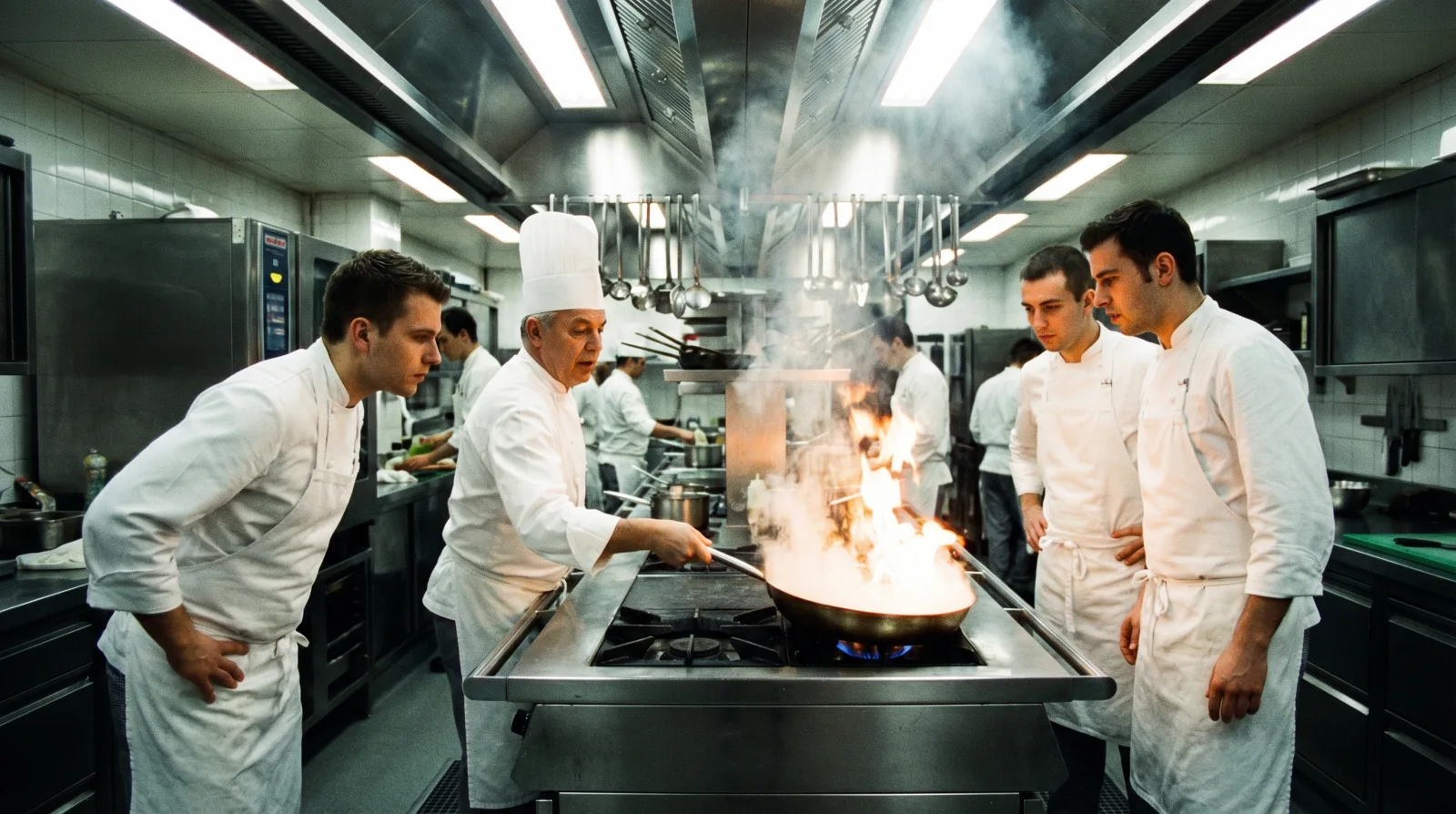
You can become a chef through on-the-job training, an apprenticeship or culinary school. No single route is required. "Chef" is a title you earn by moving up the kitchen brigade, so in every route the job itself is the real training.
Do you need culinary school to be a chef?
No. According to the US Bureau of Labor Statistics, the typical entry requirement for chefs and head cooks is a high school diploma or equivalent; many also attend culinary programs and others learn through apprenticeships. For cooks, BLS says most learn on the job. Culinary school can speed up the basics, but it does not replace time on the line.
Training routes compared
| Route | Time | Best for |
|---|---|---|
| On the job, starting as kitchen assistant or commis | Depends on the person | Earning while learning, no entry requirement |
| Apprenticeship | 1–2 years in the UK at Levels 2–4 | Structured training with pay |
| College course | Varies | Learning technique before a first job |
| Culinary degree | Often 2–4 years | Management, teaching or international ambitions |
The UK National Careers Service lists university, college, apprenticeship and direct entry as a kitchen assistant or trainee commis chef. Hours are typically 40–45 a week, often with evenings, weekends and bank holidays.
How to become a chef in Türkiye
| Route | Time | What it gives you |
|---|---|---|
| Vocational high school, food and beverage services | 4 years | Diploma and a workplace-opening certificate |
| Vocational training centre (MESEM), cookery branch | Formal apprenticeship | Journeyman and master certificates |
| Cookery associate degree | 2 years | Diploma, with a route to a bachelor's through the DGS exam |
| Gastronomy and Culinary Arts bachelor's | 4 years | Diploma |
| Working, then certification | Depends on the person | MYK certificate, then the master's exam |
MYK Cook Level 4. The official certificate supplement states there is no entry requirement. Candidates sit theory and practical exams at authorised bodies and must pass all 10 mandatory units, from safety and hygiene to soups, sauces, meat and fish, vegetables, pastry, rice and pasta, and basic desserts. The 40 occupations added by Communiqué 2026/1 do not include cooks.
Master certificate. Under Law 3308, licensing bodies must require a master certificate or at least an associate degree from the owner or at least one employee per trade branch. Holders of MYK Level 4 or above can sit the master's exam.
Hygiene. Staff in food workplaces need the hygiene training certificate.
Legal details change, so confirm with the relevant authority. This is general information, not legal advice.
The chef career path
| Stage | Role | What you learn |
|---|---|---|
| 1 | Kitchen assistant, commis | Knife work, prep, hygiene, speed |
| 2 | Demi chef de partie, chef de partie | Running a station through service |
| 3 | Sous chef | Running service and a team, reading costs |
| 4 | Head chef | Menu, purchasing, food cost, hiring |
| 5 | Executive chef, consultant, owner | Several kitchens, investment, strategy |
The National Careers Service describes a similar path, and notes that head chefs can move into hospitality management, multi-site roles or their own business. For what each level earns, see our chef salary data.
What to learn first
- 1The language of the kitchen: culinary terms glossary
- 2Preparation discipline: mise en place
- 3Food safety: the danger zone and cross-contamination
- 4Doneness and heat: steak doneness chart
- 5The numbers: prime cost
Businesses that want to develop new starters systematically can look at our kitchen team training.